
Outdoor Headshots: The Honest Guide to Getting One That Looks Professional
Search "outdoor headshots" and you will mostly find mood boards. When we checked Google's US results in November 2026, three of the top seven organic results were Pinterest pins and one was a stock photo library. Most of the written advice that does rank comes from local photographers, and it ends with "book a session."
That's fine if you've already decided to hire someone. But most people asking about outdoor headshots really want to know three things:
- Will an outdoor headshot look professional enough for my job?
- Can I take one myself, or do I need a photographer?
- Can an AI headshot generator put me outside convincingly, and how do I tell if it can't?
We review AI headshot tools for a living, so we've seen plenty of fake parks and suspicious sunsets. This guide compares all three routes honestly and tells you which one fits your situation.
What Counts as an Outdoor Headshot?
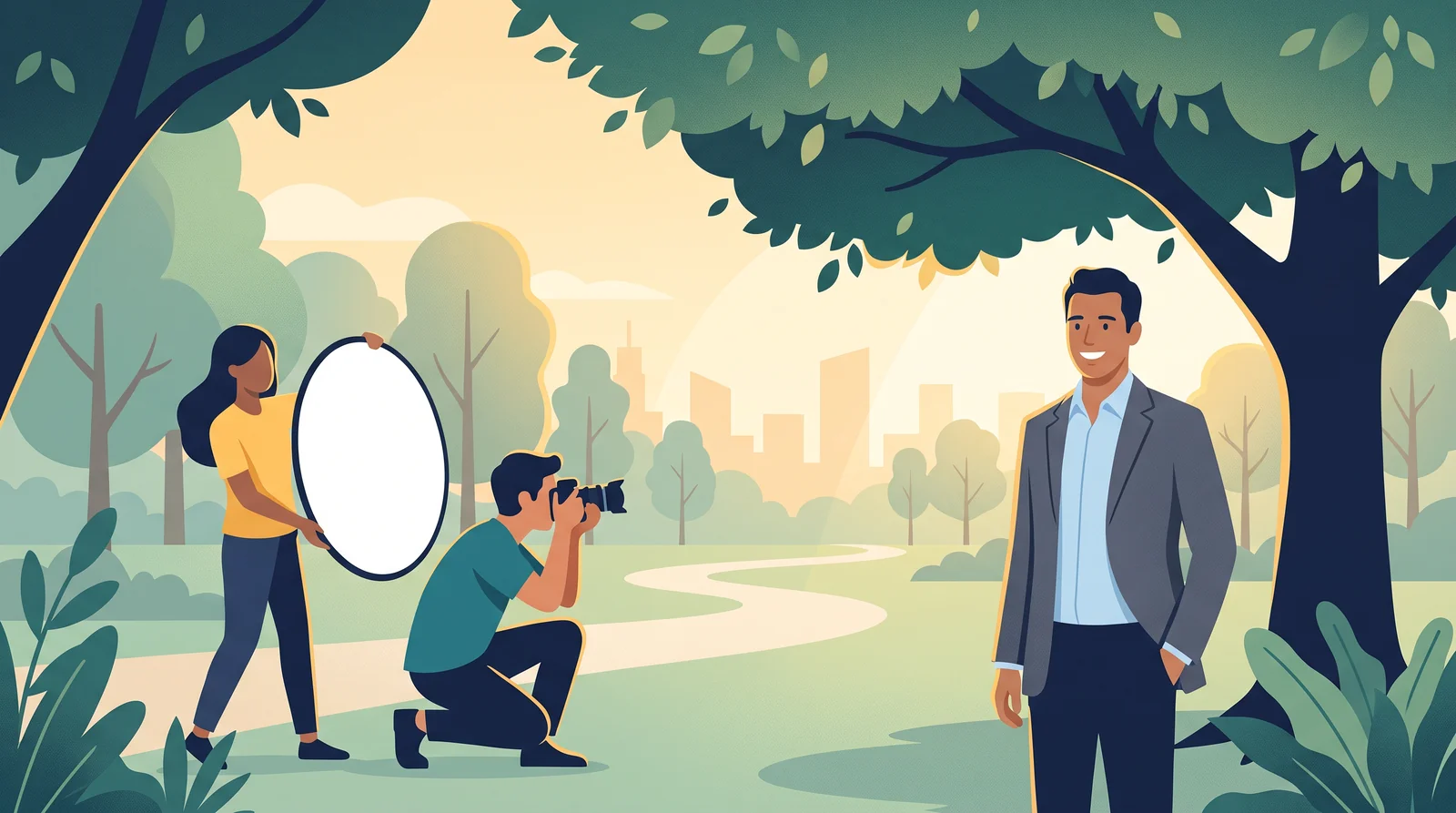
An outdoor headshot is a head-and-shoulders portrait taken in natural daylight outside a studio. The background might be trees, a park, brick, a quiet street or modern architecture, usually blurred so your face stays the focus.
It isn't a vacation photo with the background cropped out. A good outdoor headshot follows the same rules as a professional studio headshot: sharp eyes, soft and flattering light, simple framing and clothing that fits your work. The only difference is that the sun does the lighting, and the sun doesn't take direction.
Outdoor vs Studio: Does the Setting Matter?
The photographers who rank for this topic disagree. Some argue that studio wins every time because you control the light. Others say outdoor shots add warmth and a story. Both are selling the kind of session they offer.
The best data we know of suggests the background matters less than either camp claims. Photofeeler analysed more than 60,000 ratings of 800 profile photos for perceived competence, likability and influence. Its finding on setting was that setting had no statistically significant effect.
What did matter were things outdoor shoots often get wrong:
- Eyes hidden by shadow, glare or hair cut competence by 0.29 and influence by 0.31 points on Photofeeler's scale.
- Sunglasses cut likability by 0.36.
- Very high color saturation cut competence by 0.31 and influence by 0.35. That's a warning about heavy "golden" filters.
- A smile with teeth raised likability by 1.35, the biggest effect in the study.
So the useful question isn't "is outdoor professional?" It's "can I control the light well enough outside?" Midday sun creates hard shadows under the brows and makes you squint, which is exactly the eye problem in the data. Handle the light and an outdoor headshot competes with studio work.
When outdoor is the better choice
- Personal brands, coaches, consultants and creatives whose clients buy a person, not a logo.
- Real estate agents who sell a place. A tree-lined street or local landmark says "I know this area." Our real estate headshot guide covers location choices in more depth.
- Founders and startup teams whose About page should feel approachable rather than corporate.
- Anyone who looks stiff in a studio. Some people relax the moment they're outside and moving.
When studio is the safer choice
- Your company has a uniform team page and everyone else is on grey.
- You work in a conservative field such as law, banking or medicine, where clients expect a formal look.
- You need actor headshots for casting. Agents generally want your face without distractions, so outdoor shots work best as a secondary look.
- Your shoot date is fixed and the forecast is unreliable.
Your Three Options, Compared
| Hire a photographer | DIY with your phone | AI headshot generator | |
|---|---|---|---|
| Typical cost | $216–$427 US average range for headshots (Thumbtack, Oct 2026) | Free, plus an optional reflector | $9.90–$34 for the paid tools we tested |
| Time | Booking, the shoot, then waiting for edits | One evening and a helper | Minutes to hours after uploading selfies |
| Light control | High: reflectors, fill flash, scouted locations | Medium: you choose the time and shade | None, because the light is generated |
| Realism risk | Low | Low, if the photo is sharp | Medium: check every image |
| Best for | Personal brands, realtors, executives | LinkedIn, résumés, small sites | Quick updates and trying out a look |
Prices are national averages or list prices at the time of testing. Your city and your photographer's experience will move them, so see our headshot cost guide for the full breakdown.
Option 1: Hiring a Photographer for a Location Shoot
A good outdoor photographer earns their fee in three places: scouting a location with clean backgrounds and good shade, timing the session to the light, and filling shadows with a reflector or a small flash so your eyes stay bright.
Ask these questions before you book:
- Can I see outdoor headshots in your portfolio, not just studio ones? Outdoor light is a different skill.
- Where would you shoot me, and at what time? A confident answer names a place and a time window. "Wherever you like at noon" is a red flag.
- What happens if it rains? Find out about rescheduling or an indoor backup before you pay.
- Do you bring fill light or a reflector? You want at least one.
- How many edited images are included, and what does retouching cover?
Location sessions can cost more than studio sessions because the photographer travels and carries gear. If you only need one LinkedIn photo, you're paying for capability you won't use. That's where the next two options come in.
Option 2: Taking Your Own Outdoor Headshot With a Phone
A recent phone and a patient friend can produce an outdoor headshot good enough for LinkedIn. You don't need a pro camera. You need to get five decisions right.
1. Pick the time: golden hour or open shade
"Golden hour" isn't a precise astronomical term. Timeanddate explains that the warm light people mean usually happens when the sun is between 6 degrees below and 6 degrees above the horizon. Near the equator that window lasts only about 50 minutes. Around 40 degrees latitude, for example New York, it takes about an hour in March. Check the exact time for your city and arrive 30 minutes early to set up.
Can't make sunrise or sunset? Use open shade: the shadow of a building, a covered walkway or a large tree, with open sky in front of you. The sky becomes a huge soft light source. Shade is often the most flattering light available at midday.
2. Face the light, not the sun
Stand in the shade and turn toward the brightest open part of the sky. Look at your eyes on the phone screen. You want a small bright reflection in each one, called a catchlight. No catchlights means the light is coming from above or behind you, so turn until you see them.
With the sun low behind you, you get a pretty rim of light in your hair, but your face may go dark. Fill it with a reflector.
3. Bounce light back with a reflector
A cheap collapsible reflector, a white foam board or a white sheet of card held at chest height and angled up bounces light into your eye sockets and under your chin. This one change removes the "raccoon eye" shadows that Photofeeler's data penalises. Use white or silver. Gold can turn skin orange.
4. Separate yourself from the background
Background blur is what makes an outdoor photo look like a headshot instead of a snapshot. You get it from distance, not from filters:
- Stand at least a few metres in front of the hedge, wall or trees, not against them.
- Use your phone's 2x or 3x lens and have your helper step back. A longer focal length flatters faces and compresses the background.
- Portrait mode helps, but check the edges around your hair and ears. Fake blur often chews through stray hairs.
- Pick backgrounds with few bright spots. Sky gaps through leaves turn into distracting white blobs.
5. Frame and pose like a pro
Hold the phone at your eye level or slightly above. Frame from mid-chest to just above your head, leaving a little room. Turn your shoulders slightly away from the camera and bring your face back toward it. Our headshot poses guide covers 12 poses, and the shoulder-to-wall lean works particularly well outdoors.
Use burst mode or take plenty of frames. Outdoor light changes from minute to minute, and a breeze will move your hair. Expect to keep only one or two.
What to wear outdoors
- Avoid green against foliage. You'll blend into the trees, and green light bouncing off leaves and grass already tints skin.
- Choose solid mid-tones: navy, charcoal, burgundy, rust, soft blue. They hold detail in daylight.
- Go easy on bright white and neon. White loses detail in sun, and neon reflects color onto your chin.
- Bring a layer. A blazer or jacket makes a casual setting read as professional.
- Leave the sunglasses off, even pushed up on your head.
Option 3: AI Headshot Generators With Outdoor Backgrounds
Many AI headshot tools will now put you in a park or on a city street without you leaving the house. When we tested AI Ease, its background options included Outdoor and Nature alongside Office and Studio, and its paid plans started at $9.90 for 30 headshots. HeadshotPhoto offered more than 50 backgrounds for $34 for 40 images and delivered in about 15 minutes.
The catch: the generator invents the light. It learns your face from your selfies, then builds the outfit, lighting and scene around it. Studio backdrops are easy to fake because studio light is even. Outdoor light is directional and messy, so this is where AI headshots most often give themselves away.
How to spot a fake-looking AI outdoor headshot
Zoom in on each result and check these six things before you post it:
- Light direction. If the background sun is on the left, the bright side of your face should be on the left too. A face lit from the front against a sunset behind you is the most common giveaway.
- Color match. Warm, golden backgrounds should put some warmth on your skin. A cool, neutral face pasted onto an orange scene looks cut out.
- Edges. Look at your hair, ears and shoulders. Halos, smudged strands or hair that melts into leaves mean the image was composited badly.
- Blur that makes sense. Real blur increases smoothly with distance. AI blur sometimes keeps a far-off bench sharp while blurring a nearby branch.
- Skin and teeth. Over-smooth "plastic" skin and identical, too-white teeth read as artificial. Photofeeler's data also penalises heavy saturation.
- Does it still look like you? Your friends should recognise you instantly. If someone you've never met would be surprised at the meeting, don't use it.
A good result passes all six. Most batches have some that do and plenty that don't, which is why tools that give you dozens of images are worth paying for.
When AI outdoor headshots are good enough
AI outdoor shots work for LinkedIn, résumés, internal directories and email signatures. People see them small, and you can swap them out any time. Our LinkedIn headshot guide explains what matters at that size.
They're riskier for speaker bios, press kits, billboards and anything printed large, where edge artifacts show. They're also risky for casting and anywhere people will compare the photo with you in person, including dating profile pictures. For those, use a real photo.
Which Route Should You Choose?
- Need it this week, on a tight budget, for LinkedIn? Try an AI generator with outdoor backgrounds and use the six checks. If nothing passes, shoot it yourself.
- Have an evening and a friend? Do a DIY golden-hour or open-shade shoot. It's free, it's really you, and it often beats AI on realism.
- Building a personal brand, selling property or needing a set of images? Hire a photographer who can show outdoor work. The scouting and fill light are worth paying for.
- Unsure whether outdoor suits your field? Get one outdoor and one plain-background version. Use the plain one where consistency matters and the outdoor one where personality does.
Outdoor headshots aren't less professional than studio ones. Bad light is unprofessional, wherever it happens. Get the light right and the setting becomes a choice about your personal brand, not a risk.
Frequently Asked Questions
How do you take an outdoor headshot?
Shoot in open shade or near sunrise and sunset, never in direct midday sun. Face the open sky so light fills your eyes, stand several metres in front of a simple background, and use a longer lens or your phone's 2x or 3x camera at eye level. A white reflector below your face fills shadows.
What colors should you not wear for an outdoor headshot?
Skip green against trees or grass, and go easy on bright white and neon, which lose detail or cast color in sunlight. Solid mid-tones like navy, burgundy, charcoal, rust and soft blue are the safest choices.
Is an outdoor headshot professional enough for LinkedIn or corporate use?
Usually, yes. Photofeeler's study found that setting had no statistically significant effect on how people were rated. Shadows over the eyes, squinting, busy backgrounds and heavy edits are what make a photo look unprofessional. Choose studio when your company needs a uniform team page or your field is conservative.
Can AI or ChatGPT create a professional outdoor headshot?
Dedicated AI headshot generators can, and several we reviewed offer outdoor or nature backgrounds. Check every result: light direction on your face should match the background, edges around hair should be clean, the blur should look natural and you should still look like yourself.
How much does a professional outdoor headshot cost?
Thumbtack's data puts the average US headshot at $304, typically $216 to $427, and location shoots can cost more. DIY is essentially free. The paid AI tools we tested started at $9.90 (AI Ease) and $34 (HeadshotPhoto).
Sources
- Photofeeler: "The Perfect Profile Photo" research study
- Timeanddate: "Golden Hour – When Sunlight Turns Magical"
- Thumbtack: "How much do photographers charge?" (last updated 28 October 2026)
- AI Headshot Reviews hands-on tests of AI Ease and HeadshotPhoto (prices at time of review; check current pricing)
- Google US search results for "outdoor headshots", retrieved via DataForSEO on 17 November 2026